The third annual conference of the Ukrainian History Global Initiative (UHGI), held from 14 to 16 September 2026 in Kyiv, brought together 80 scholars to produce a comprehensive history of Ukraine through the history of the world, and a comprehensive history of the world through the history of Ukraine
A different kind of academic conference
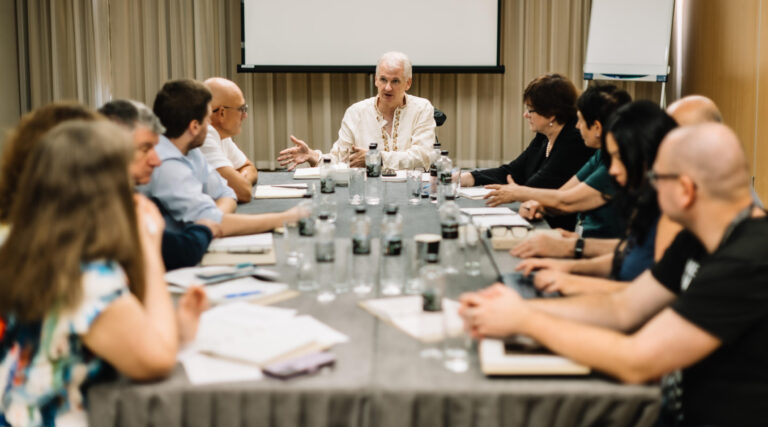
Unlike conventional academic conferences, the Kyiv gathering was organised around collaborative work without formal presentations.
Over three days, participants discussed 58 research papers in 58 dedicated workshops. Each session brought together authors and fellow scholars to examine drafts, challenge interpretations, explore connections between different periods of history, and consider how complex academic research could be communicated to readers beyond academia.


Photos by Kateryna Lashchykova
There were no slideshow presentations and no hybrid online participation. The emphasis was on being together in the same room, reading one another’s work, exchanging ideas, and building the intellectual relationships that make a project of this scale possible.
For many participants, the conference was also an opportunity to reconnect with colleagues who have been working together since the Initiative began, while welcoming new contributors who joined the project this year.
The discussions reflected one of UHGI’s central ambitions: to produce history that meets rigorous scholarly standards while remaining engaging and accessible to a broad public.
That requires more than simplifying academic language. It means developing narratives that help readers understand why historical events matter, how different periods and places are connected, and how Ukraine’s past forms part of a much larger human story.
Building a scholarly community in wartime
The decision to gather in Kyiv carried particular significance as Russia’s full-scale invasion of Ukraine continues.
For international participants, travelling to the conference meant experiencing some of the realities of wartime Ukraine firsthand. For Ukrainian researchers, it meant continuing their academic work amid the challenges and uncertainty of war.
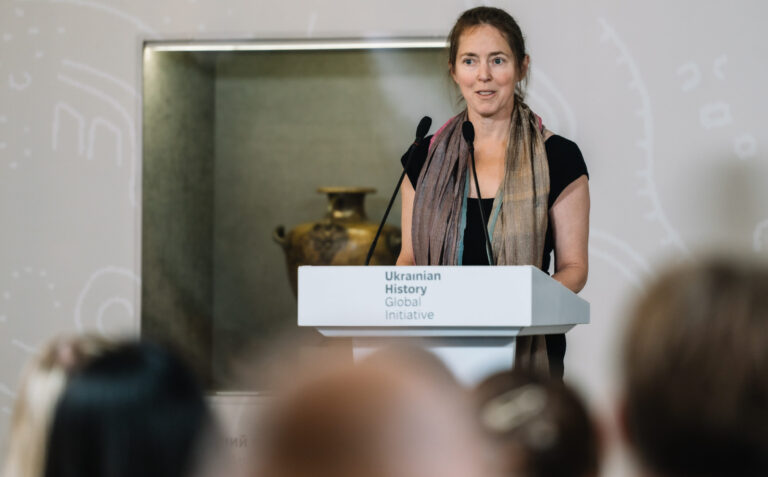
Susan Bonner, a Canadian journalist and Senior Fellow at the University of Toronto’s Munk School of Global Affairs and Public Policy, joined UHGI’s Academic Council this year, bringing four decades of experience in journalism and public communication.
Her journey to Kyiv was disrupted by a Russian drone attack on railway infrastructure near the Ukrainian-Polish border. Travelling alongside other UHGI participants, she experienced lengthy delays and an evacuation to a railway station shelter before reaching the capital.
In an article published in Policy Magazine following the conference, Bonner reflected on the experience of travelling through a country at war to join an international project devoted to making Ukraine’s past accessible to a global audience.
Her account illustrates a central idea behind the Initiative: understanding Ukraine’s present requires a deeper understanding of its past and of the country’s place in world history.
For Timothy Snyder, the gathering also demonstrated the importance of scholarly collaboration at a time when isolation and intimidation threaten intellectual life.
In his closing remarks, he reflected on what participants had achieved together:
“We’re certainly working against isolation. We’re working against over-specialization. We’re working against intimidation. We’re working against demoralization and nihilism.”
But the purpose of the gathering, he emphasised, was not simply to resist these pressures. It was also to build something together: a community founded on intellectual exchange, mutual support, and a shared commitment to historical truth.
“We’re working towards community,” he said, “but also affirmation of the principle that we can pursue scholarly truth and that you can do it together.”
From academic research to books and a digital experience
Over the past three years, researchers have been investigating subjects spanning thousands of years of history. Their work encompasses archaeology, the movement of peoples, cultural and religious exchange, political developments, and the many connections between Ukraine and the wider world.
During the conference, researchers also met members of UHGI’s editorial team led by Clive Priddle. The editorial process will be accompanied by the development of maps, illustrations, and other visual materials to help bring the research to life.
As Snyder explained in his closing remarks, “We’re doing both scholarly and popular history,” he said. “We’re meant to be doing both written history and experienced history.”


Photos by Kateryna Lashchykova
The conference ended with a shared understanding that the work ahead extends beyond finishing individual manuscripts. It is about bringing together years of research into a history of Ukraine that can be read, explored, and experienced by people around the world.
And, as the gathering in Kyiv demonstrated, that work begins with the people willing to come together to make it possible.