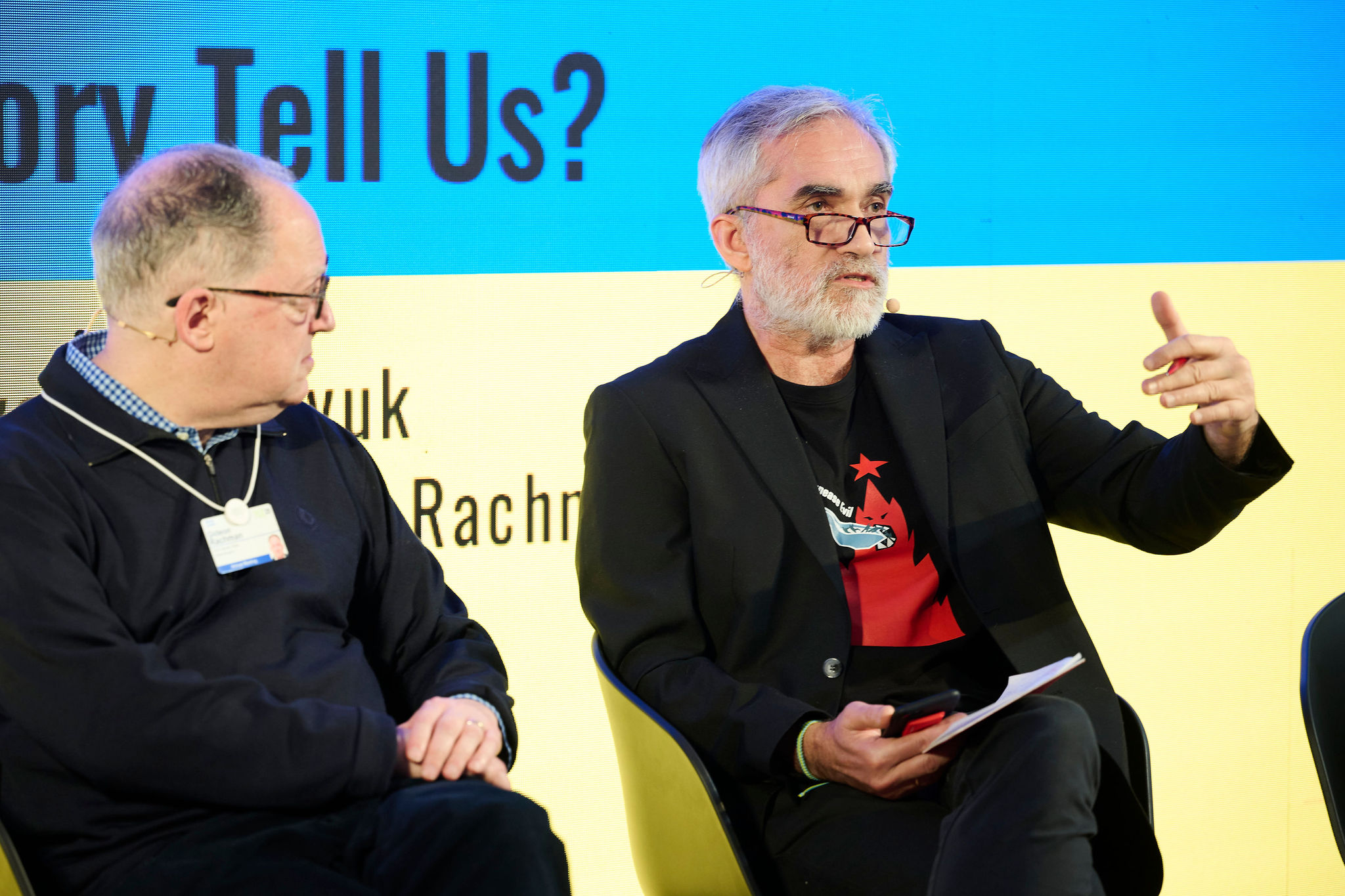
DAVOS, Switzerland — On the third day of the Ukrainian program at the World Economic Forum, a discussion titled “The Stakes of the War: What Can History Tell Us?” explored the lessons of history and their relevance to contemporary challenges. The panel, hosted as part of the “Your Country First – Win With Us” program organized by the Victor Pinchuk Foundation and PinchukArtCentre.
Moderated by Nataliia Gumenyuk, co-founder of the Public Interest Journalism Lab and The Reckoning Project, the discussion featured historians and co-chairs of the Academic Council of the UHGI – Timothy Snyder and Yaroslav Hrytsak, alongside Gideon Rachman, chief foreign affairs commentator at The Financial Times, and Walter Russell Mead, global view columnist for The Wall Street Journal.
The discussion challenged the notion of invincible empires and nuclear powers, highlighting that they often lose. This underscores Ukraine’s resilience and demonstrates how nations defending their territory can prevail against imperial aggression. It also emphasized Ukraine’s sovereignty as crucial to global stability. Timothy Snyder stated, “Over the course of the war, we have taken three years to recognize that Ukraine is not merely marginal, but central to world history.”
Addressing Russia’s nuclear threats, Snyder called for a global stance against nuclear blackmail: “If nuclear powers can be defeated by conventional means, we ensure stability and prevent dangerous nuclear proliferation.”
Yaroslav Hrytsak complemented Snyder’s analysis by framing Ukraine’s identity through the lens of resilience. “If I had to summarize Ukrainian history in one sentence, it would be: ‘Now you see me, now you don’t,’” he remarked, noting that Ukraine’s significance is often overlooked during peaceful times but becomes undeniable in moments of crisis.
Hrytsak traced Ukraine’s trajectory of resilience back to the 17th-century Kozak State, a formative period when Ukraine’s alignment with Moscow marked a turning point in the rise of imperial Russia. He also emphasized that transformative reforms are critical for young nations, underscoring that crises often provide the impetus for necessary change, arguing that Ukraine’s path mirrors the patterns of other young countries that have emerged stronger through crises and reforms.
The World Economic Forum was originally envisioned as a platform to shape the future. However, in practice, its agenda often remains anchored in contemporary events, crises, and challenges. Increasingly, history has taken center stage in these discussions, highlighting the critical role of understanding the past to navigate present uncertainties. As a result, historical analysis has become essential in addressing today’s complex global issues. “Wars fought over Ukraine have historically shaped future centuries,” Snyder noted.
Furthermore, our members were engaged in various panels. We invite you to view the discussion featuring Phillips O’Brien, who conducts thematic research on “The Wars for Ukraine.”